

Dental implants need precision cleaning that regular floss often cannot deliver. This guide breaks down every Waterpik model, tip, and setting so your implants stay healthy long-term.
Dental implants are a long-term investment. They can last decades, but only if the tissue around them stays healthy. The problem is that standard string floss struggles to reach the contours around implant crowns and under implant-supported bridges. Plaque builds in those gaps, and when it does, the consequences are serious.
Water flossers, and specifically Waterpik models, solve this problem. A pressurized water stream clears biofilm from areas string floss cannot reach, stimulates the gum tissue around the implant, and reduces the bacterial load that drives peri-implant disease.
This guide covers what to look for, which models perform best for implants, the right tips to use, proper technique, correct pressure settings, and how different implant types each require slightly different approaches. Every product below stays available through Amazon, and the affiliate links are kept intact so you can check current pricing directly.
Quick Picks: Best overall is the Waterpik Aquarius. Best cordless option is the Waterpik Cordless Advanced 2.0. Best premium choice is the Waterpik ION. Best for implant-supported dentures is the Waterpik Ultra Professional. Best combo device is the Waterpik Sonic-Fusion.
Why Dental Implants Need Special Care
Understanding Peri-Implant Mucositis
Peri-implant mucositis is reversible inflammation of the soft tissue directly surrounding a dental implant. It develops when plaque accumulates at the implant-gum interface and is not removed consistently. The gum becomes red, swollen, and bleeds on probing. At this stage, the condition responds well to improved cleaning. Left untreated, it progresses to something far more damaging.
What Is Peri-Implantitis?
Peri-implantitis is peri-implant mucositis that has spread to the supporting bone. The bone recedes around the implant, the implant loosens, and without intervention, it fails. This is the primary reason implants are lost after successful placement. Unlike natural teeth, implants have no periodontal ligament to buffer bacterial invasion, making the surrounding tissue more vulnerable once infection establishes itself.
Why Traditional Floss Is Not Always Enough
String floss works well between natural teeth where tight contact points give it something to work against. Around implants, the crown shape, the presence of crown margins, and the anatomy under implant-supported bridges create spaces that string floss skims over rather than cleans. Threading floss under a fixed bridge is awkward, and most patients do it inconsistently as a result.
Benefits of Water Flossing Around Implants
A water flosser delivers a pulsating stream directly into the sulcus around the implant, disrupting and flushing biofilm before it mineralizes into calculus. It reaches the full circumference of the implant crown in a single motion. Research cited by Waterpik shows that using a Waterpik with the Plaque Seeker Tip produces better gum health outcomes around implants than string floss alone. For patients with multiple implants, implant-supported bridges, or All-on-4 restorations, water flossing is not a supplement. It is the primary tool.
What Makes a Waterpik Good for Dental Implants?
Adjustable Pressure Settings
Pressure flexibility matters most in the weeks after implant placement when tissue is healing, and again for patients with chronic gum sensitivity. A model with 10 settings gives you a wide enough range to start gentle and increase gradually as comfort and tissue health improve. Models with only 2 or 3 settings limit this progression.
Plaque Seeker Tip Compatibility
The Plaque Seeker Tip is Waterpik’s primary tip for implant care. It has three small bristle tufts at the end that physically contact the implant crown surface and remove plaque mechanically while the water stream flushes the sulcus. Any Waterpik model that accepts standard tips accepts the Plaque Seeker, but verify compatibility before purchasing accessories.
Implant Denture Tip Availability
If you have implant-supported bridges, All-on-4, or All-on-6 restorations, the Implant Denture Tip gives you access to the space under the bridge where bacterial buildup is most problematic. This tip works with most countertop Waterpik models.
Large Water Reservoir
Cleaning multiple implants or a full-arch restoration takes more water than cleaning natural teeth. A reservoir under 200ml will run dry mid-session. Countertop models like the Aquarius carry enough water to complete a full session without refilling. Cordless models accept the trade-off of a smaller reservoir for portability.
Countertop vs Cordless Designs
Countertop models deliver consistent pressure and larger reservoirs, making them the stronger choice for primary home use with multiple implants. Cordless models are rechargeable and waterproof, making them practical for travel and as a secondary device. The right choice depends on how many implants you have and whether you travel frequently.
Ease of Daily Use
Compliance drives outcomes. The best model is the one you actually use every day. If setup is complicated or messy, usage drops. Consider where you will store it, how you will fill it, and whether a cordless design fits better into your bathroom routine.
Best Waterpik for Dental Implants (Quick Comparison)
| Model | Best For | Pressure Settings | Reservoir | Plaque Seeker | Rating |
|---|---|---|---|---|---|
| Waterpik Aquarius | Most implant patients | 10 | Large | Yes | ★★★★★ |
| Waterpik ION | Cordless countertop users | 10 | Extra Large | Yes | ★★★★★ |
| Waterpik Cordless Advanced 2.0 | Travel and portability | 3 | Medium | Yes | ★★★★ |
| Waterpik Promax | SmartAdvance pressure ramp | 10 | Large | Yes | ★★★★★ |
| Waterpik Cordless Pearl | Quiet travel use | 3 | Medium | Yes | ★★★★ |
| Waterpik Cordless Pulse 3100 | Shower use | 2 | Small | Yes | ★★★★ |
Best Overall Waterpik for Dental Implants
Best Overall
Waterpik Aquarius Professional Water Flosser (WP-660, White)

The Aquarius is the benchmark for implant care among Waterpik countertop models. It ships with the Plaque Seeker Tip, which Waterpik specifically identifies as the correct tip for implant maintenance. The three-bristle-tuft design at the tip end makes direct mechanical contact with the implant crown while the water stream clears the sulcus simultaneously.
Ten pressure settings give you genuine range. New implant patients and those with sensitive tissue start at 1 or 2 and move up gradually. Long-term implant patients doing routine maintenance typically settle between 5 and 7. The massage mode pulses at a different rhythm, which some patients find useful for gum stimulation between implants.
The large reservoir holds enough water to clean a full arch plus natural teeth without refilling. The ADA has accepted it for safety and effectiveness. For patients with single implants, multiple implants, or implant-supported bridges, this model handles all three cases well.
Pros
- Ships with Plaque Seeker Tip
- 10 pressure settings with genuine range
- Large reservoir for full-arch sessions
- Massage mode for gum stimulation
- ADA accepted
- Clinically supported for implant care
Cons
- Requires countertop space
- Not portable for travel
- Needs a nearby outlet
Best for: Single implants, multiple implants, implant-supported bridges, and patients who want the highest-pressure range available.
Best Overall (Black)
Waterpik Aquarius Professional Water Flosser (WP-662, Black)

The WP-662 is the same Aquarius platform in a black finish. It carries the identical 10 pressure settings, large reservoir, and full tip compatibility including the Plaque Seeker and Implant Denture Tip. The 7 included tips support multiple users in the same household, each with different dental needs.
Performance is identical to the WP-660. The choice between white and black comes down to bathroom aesthetics. Both models deliver the consistent pressure and tip compatibility that implant care requires.
Pros
- Same performance as WP-660
- 7 interchangeable tips for multiple users
- 10 adjustable pressure settings
- ADA accepted
- Compact footprint for a countertop unit
Cons
- Requires power outlet
- Not suitable for travel
Best Cordless Waterpik for Dental Implants
Best Cordless
Waterpik Cordless Advanced 2.0 Water Flosser (WP-580)

The Cordless Advanced 2.0 is the travel companion for implant patients who cannot go a day without proper cleaning. The rechargeable battery and IPX7 waterproof rating mean it works in the shower, which is often the most convenient place to water floss when away from home.
It accepts the Plaque Seeker Tip, so your implant cleaning routine stays intact regardless of location. Three pressure settings cover gentle, standard, and deep clean modes. The reservoir is smaller than countertop models, but holds enough for most single-arch sessions. The included travel bag keeps everything organized during trips.
Weighing 0.8 pounds and at 11.6 inches tall, this is genuinely portable. ADA accepted.
Pros
- Fully rechargeable, no outlet needed
- IPX7 waterproof for shower use
- Accepts Plaque Seeker Tip
- Travel bag included
- ADA accepted
- Lightweight at 0.8 pounds
Cons
- Only 3 pressure settings
- Smaller reservoir than countertop units
- Battery degrades with long-term heavy use
Best for: Frequent travelers, patients with one or two implants who want consistent cleaning on the road.
Quietest Cordless
Waterpik Cordless Pearl Rechargeable Portable Water Flosser (WF-13)

The Cordless Pearl runs quieter than most water flossers in its class. For patients who share bathrooms or who water floss early in the morning or late at night, noise level matters. The extra-quiet motor makes the Pearl a practical daily driver without disturbing anyone nearby.
It comes with 4 flossing tips and accepts the Plaque Seeker Tip for implant care. Rechargeable and ADA accepted. The reservoir is smaller than countertop units, so patients with multiple implants may need to refill mid-session.
Pros
- Extra-quiet operation
- 4 flossing tips included
- Rechargeable and portable
- ADA accepted
- Compact pearl-white design
Cons
- Smaller reservoir
- Fewer pressure levels than countertop models
- Higher price point for a cordless unit
Best Premium Waterpik for Implant Maintenance
Best Premium
Waterpik ION Professional Water Flosser (WF-12)

The ION bridges the gap between a cordless and a traditional countertop unit. It is rechargeable, so there is no cord during use, but it sits on the counter and charges in place. This gives you the freedom of a cordless device with the larger reservoir capacity closer to a countertop model.
Ten pressure settings match the Aquarius range. Seven flossing tips support multiple users. The water stream runs quieter than the standard Aquarius motor, which some patients strongly prefer. For patients with multiple implants who want premium performance without cord management, the ION is the right choice.
Pros
- Rechargeable countertop design, no cord during use
- 10 pressure settings
- 7 flossing tips for multiple users
- Quieter operation than standard countertop units
- Accepts Plaque Seeker Tip
- ADA accepted
Cons
- Higher price than Aquarius
- Less powerful than corded models at maximum setting
- Packaging may vary
Best for: Patients with multiple implants who want a quiet, rechargeable countertop system with full pressure range.
Best Waterpik for Implant-Supported Dentures
Best for Denture Implants
Waterpik Promax Water Flosser (WF-23)

The Promax introduces SmartAdvance Mode, which ramps pressure up gradually from a gentle start rather than hitting full pressure immediately. This is particularly valuable for patients with implant-supported dentures and All-on-4 or All-on-6 restorations, where the tissue under the bridge can be sensitive and an abrupt high-pressure stream creates discomfort.
Paired with the Implant Denture Tip, the Promax cleans the space beneath fixed implant bridges where bacterial accumulation is highest. Five included tips cover a range of needs. The compact 8.2 x 3.6 x 6.2-inch footprint fits smaller bathroom counters, and the quiet operation makes daily use unobtrusive.
Pros
- SmartAdvance Mode for gradual pressure ramp
- 10 pressure settings
- Compatible with Implant Denture Tip
- Quiet operation
- Compact footprint
- ADA accepted
Cons
- Requires countertop outlet
- Not travel-ready
- Learning curve for SmartAdvance settings
Best for: All-on-4, All-on-6, full-arch restorations, and implant-supported bridges where under-bridge cleaning is the priority.
Best Portable Option for Travel
Best for Shower Use
Waterpik Cordless Pulse 3100 (WF-20)
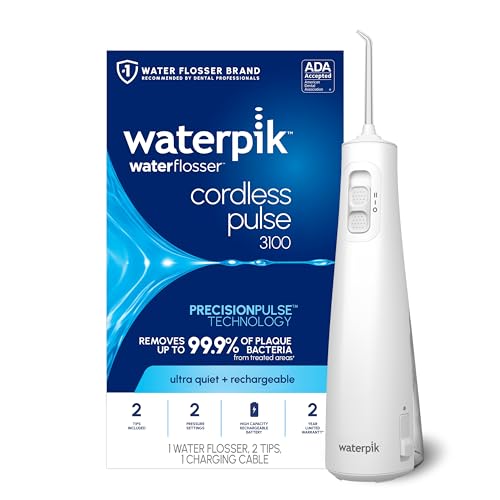
At 0.65 pounds, the Cordless Pulse 3100 is Waterpik’s lightest rechargeable option. The full IPX7 waterproof rating makes it safe for shower use, which many implant patients prefer because the sink cleanup is eliminated. Two flossing tips are included, and the Plaque Seeker Tip is compatible.
The reservoir is the smallest in the Waterpik lineup, so patients with All-on-4 or multiple implant arches will need to refill. For single-implant patients or those using it as a travel supplement to their home Aquarius, the Pulse 3100 fills the role well. ADA accepted.
Pros
- Lightest Waterpik at 0.65 pounds
- Full shower use with IPX7 rating
- Rechargeable
- ADA accepted
Cons
- Smallest reservoir in the lineup
- Only 2 pressure settings
- Not suitable for full-arch restoration patients as primary device
Essential Accessory
Waterpik Genuine Implant Denture Replacement Tips (DT-100E)
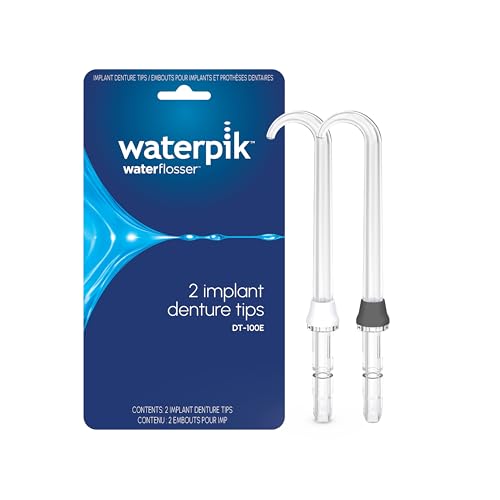
If you have a fixed implant bridge, All-on-4, or All-on-6 restoration, the Implant Denture Tip is a required purchase. The nozzle geometry angles the water stream into the space beneath the bridge, which is the highest-risk zone for bacterial accumulation in fixed implant restorations.
This 2-pack comes in assorted colors, making it easy to identify individual tips when multiple household members share the same base unit. Compatible with most Waterpik water flossers. Tips should be replaced every 3 to 6 months for optimal performance.
Pros
- Designed specifically for under-bridge cleaning
- Works with most Waterpik models
- Assorted colors for household identification
- Durable and easy to install
Cons
- Waterpik-only compatibility
- Requires periodic replacement
Budget Alternative
COSLUS Water Dental Flosser Teeth Pick C20

The COSLUS C20 is ADA accepted and offers a 300ml reservoir in a cordless, rechargeable body. The IPX7 waterproof rating supports shower use. At 0.97 pounds, it sits between the lightest Waterpik cordless models and mid-range travel units in terms of weight and reservoir size.
It does not accept Waterpik-specific tips like the Plaque Seeker or Implant Denture Tip, which is a meaningful limitation for implant patients. If you have natural teeth alongside your implants and want a budget-friendly cordless option, the C20 delivers good general performance. For implant-specific care, the Waterpik ecosystem with dedicated implant tips provides a more complete solution.
Pros
- ADA accepted
- 300ml reservoir
- IPX7 waterproof
- Rechargeable
- Budget-friendly price point
Cons
- Does not accept Waterpik Plaque Seeker Tip
- No Implant Denture Tip compatibility
- Single color option
Multi-Mode Cordless
WELLFINE Water Dental Flosser Teeth Pick

The WELLFINE offers four adjustable modes and a 300ml reservoir in a cordless, IPX7-rated body. For implant patients who cannot access Waterpik-brand units or who want a secondary travel device, the four modes provide more pressure options than many competing cordless units at a similar price point.
Like the COSLUS, it does not accept Waterpik-specific implant tips. General cleaning around implant crowns is achievable, but patients with fixed bridges or complex restorations will get better targeted results from a Waterpik-specific model with the Implant Denture Tip.
Pros
- Four adjustable cleaning modes
- 300ml reservoir
- IPX7 waterproof
- Rechargeable, long battery life
Cons
- No Waterpik implant tip compatibility
- Single color option
Which Waterpik Tip Is Best for Dental Implants?
Waterpik identifies two tips as its primary implant-care accessories. Choosing the right one depends on the type of restoration you have.
Plaque Seeker Tip
Three small bristle tufts at the tip end make direct mechanical contact with the implant crown surface while the water stream clears the surrounding sulcus. Waterpik identifies this as the primary tip for single implants and implant crowns. Included with the Aquarius.
Implant Denture Tip
Angled nozzle design delivers the water stream under fixed implant-supported bridges. This is the correct tip for All-on-4, All-on-6, and any multi-unit fixed bridge where the space beneath the restoration is the primary cleaning challenge.
Classic Jet Tip
The standard Waterpik tip, suitable for daily maintenance of natural teeth alongside implants. Not optimized specifically for implant care, but useful as part of a multi-tip household routine where different users have different needs.
Waterpik’s guidance: Use the Plaque Seeker Tip for implant crowns and the Implant Denture Tip for fixed implant bridges and full-arch restorations like All-on-4 and All-on-X.
Waterpik vs String Floss for Dental Implants
Plaque Removal Comparison
String floss removes plaque through mechanical scraping between tooth contact points. Around implants, the crown shape and subgingival margins create geometry that string floss scrapes past rather than cleaning thoroughly. Water flossers deliver a pulsating stream into the sulcus and around the full circumference of the implant crown, disrupting and flushing biofilm in a single motion.
Gum Health Benefits
Research cited by Waterpik shows that using a Waterpik with the Plaque Seeker Tip produces better gum health outcomes around implants than string floss alone. The pulsating action also stimulates circulation in the peri-implant tissue, which supports healing and long-term tissue health.
Ease of Use Around Implants
String floss requires threading under implant-supported bridges with a floss threader, a process most patients find awkward and skip regularly. A water flosser reaches the same spaces in seconds without threading. Compliance is significantly higher with water flossers, and consistent daily cleaning produces better outcomes than perfect technique used infrequently.
Why Dentists Often Recommend Both
Water flossing excels at disrupting and flushing biofilm from the peri-implant sulcus and under bridges. String floss, where it can reach, still provides effective contact-point cleaning between adjacent teeth. Most prosthodontists and periodontists recommend using both tools for patients with natural teeth alongside implants, with the water flosser as the primary tool for the implant sites themselves.
How to Use a Waterpik Safely Around Dental Implants
Step-by-Step Guide
- Fill the reservoir with lukewarm water. Cold water can increase sensitivity, especially around newly placed implants.
- Attach the Plaque Seeker Tip (or Implant Denture Tip for bridges). Ensure it clicks securely into the handle.
- Set the pressure to 1 or 2 if you are new to water flossing or recently had implant surgery. Experienced users with healthy tissue can start at 5.
- Lean over the sink with your lips slightly closed around the tip to control water spray. You can also use it in the shower.
- Aim the tip at the gumline at a 90-degree angle to the implant crown, or slightly angled toward the gum crevice.
- Move slowly around each implant, pausing briefly at the contact points and at the gumline on both the cheek side and the tongue side.
- For implant bridges, angle the Implant Denture Tip into the space under the bridge and move slowly from one end to the other.
- Clean between implants and between implants and adjacent natural teeth before moving on.
- Rinse the reservoir and tip after each use and store with the tip removed to allow drying.
Common Mistakes to Avoid
Starting at maximum pressure: Full pressure on healing or sensitive tissue causes discomfort and can irritate the sulcus. Start low and increase over days or weeks.
Skipping daily cleaning: Biofilm builds within 24 hours. Missing even one day allows bacterial load to increase around the implant.
Using worn-out tips: Tips degrade with use. Replace the Plaque Seeker Tip every 3 to 6 months. Worn bristles do not make effective mechanical contact with the implant crown surface.
Waterpik Settings for Dental Implants
1 to 3
New Implant Patients
Use low pressure for 4 to 6 weeks after implant surgery. Tissue is healing and cannot tolerate high-pressure streams. Consult your prosthodontist before starting water flossing post-surgery.
4 to 6
Sensitive Gums
Mid-range settings work well for patients with ongoing gum sensitivity or who find higher pressure uncomfortable. This range still delivers effective cleaning.
7 to 10
Long-Term Maintenance
Healthy tissue around established implants responds well to higher pressure. Higher settings increase biofilm removal efficiency and gum stimulation.
Waterpik for Different Types of Dental Implants
Single Tooth Implants
The Aquarius with the Plaque Seeker Tip handles single implants completely. The full circumference of the crown is reachable in a single motion. Any countertop Waterpik with 10 settings works well for this restoration type.
Multiple Dental Implants
Multiple implants require more water per session and benefit from a larger reservoir. The Aquarius or ION are the correct choices here. Use the Plaque Seeker Tip on each implant crown systematically, moving from one side to the other.
Implant Bridges
Implant bridges require the Implant Denture Tip to clean the space beneath the bridge. The Promax with its SmartAdvance Mode is well-suited here, as the gradual pressure ramp prevents discomfort at the bridge tissue contact points.
All-on-4 Implants
All-on-4 restorations create a long bridge supported by four implants. The space beneath this bridge accumulates bacterial biofilm rapidly. Daily use of the Implant Denture Tip with a countertop Waterpik model is essential. The Promax or Aquarius with Implant Denture Tips are the correct setup.
All-on-6 Implants
All-on-6 follows the same cleaning protocol as All-on-4 with the Implant Denture Tip. The additional two implants provide more support points but also more sulcus to clean. Sessions take slightly longer than All-on-4, making a large reservoir important.
Full-Arch Restorations
Full-arch restorations require the longest sessions and the largest reservoir. The Aquarius or ION are the correct primary devices. The Implant Denture Tip is essential. Patients with full-arch restorations should work with their prosthodontist to establish a complete daily protocol.
Common Questions About Waterpik and Dental Implants
Can a Waterpik Damage Dental Implants?
No. A Waterpik used at appropriate pressure settings does not damage implant fixtures, abutments, or crowns. The risk of damage is associated with using extremely high pressure on recently placed implants before the tissue has healed. Start at low pressure and increase gradually based on tissue response and your prosthodontist’s guidance.
Is Waterpik Safe After Implant Surgery?
Most prosthodontists recommend waiting at least 4 to 6 weeks after implant surgery before beginning water flossing at the implant site. After that period, start at the lowest pressure setting and increase slowly. Always follow your surgeon’s specific post-operative instructions, as healing timelines vary by patient and procedure.
How Often Should You Water Floss Implants?
Daily use is the standard recommendation. Biofilm accumulates within 24 hours, so once-daily water flossing at the implant sites keeps bacterial load consistently low. Many patients incorporate it into their morning or evening routine alongside brushing.
Can Waterpik Prevent Peri-Implantitis?
Consistent water flossing significantly reduces the plaque and bacterial biofilm that drive peri-implantitis development. It cannot guarantee prevention, as individual bone density, systemic health, smoking history, and other factors also contribute. However, it is one of the most effective daily tools available for reducing peri-implant disease risk.
Which Waterpik Pressure Setting Is Best?
New patients and post-surgical patients: settings 1 to 3. Patients with sensitive tissue: settings 4 to 6. Long-term implant patients with healthy tissue: settings 7 to 10. The goal is the highest setting that you can use comfortably and consistently.
Should I Use Mouthwash in My Waterpik?
Some patients add a small amount of alcohol-free antimicrobial mouthwash to the reservoir. This can enhance antibacterial effects around implants. Avoid alcohol-based mouthwashes, as they can dry the mucosa and degrade the internal components of the water flosser over time. Always check your Waterpik model’s guidance on additives before use.
Can Waterpik Replace Traditional Floss?
For implant sites specifically, a Waterpik with the Plaque Seeker Tip outperforms string floss. For natural teeth with tight contact points alongside your implants, combining both tools provides the most thorough cleaning. Waterpik complements and often outperforms string floss at implant sites, but complete replacement depends on your specific dental anatomy.
Final Verdict: Which Waterpik Is Best for Dental Implants?
Your restoration type and lifestyle determine the right model. Here is the summary without compromise.
Best Overall
Waterpik Aquarius
10 settings, large reservoir, ships with Plaque Seeker Tip, ADA accepted. The correct first choice for most implant patients.
Best Cordless
Waterpik Cordless Advanced 2.0
Rechargeable, waterproof, travel bag included, accepts Plaque Seeker Tip. The correct travel companion.
Best Premium
Waterpik ION
Rechargeable countertop system with full 10-setting range and quiet motor. Best for multiple implant patients who prioritize noise reduction.
Best for Bridges and Dentures
Waterpik Promax
SmartAdvance Mode plus Implant Denture Tip compatibility. The correct choice for All-on-4, All-on-6, and fixed bridges.
Quietest Cordless
Waterpik Cordless Pearl
Extra-quiet motor and 4 tips in a compact rechargeable body. Best for shared bathrooms and noise-sensitive environments.
Must-Have Accessory
Implant Denture Tips (DT-100E)
Required purchase for any fixed implant bridge or full-arch restoration. Buy alongside your Waterpik unit.
The bottom line: Dental implants represent a significant investment in your oral health. Daily water flossing with the correct Waterpik model and the right implant-specific tip is the single most effective daily habit you can build to protect that investment long-term. The Aquarius handles most situations. Add the Implant Denture Tip if you have a fixed bridge. Pair with the Cordless Advanced 2.0 if you travel regularly.
